

© Gérôme Truc
Testimonials and investigative reports
Published on
26th June 2026
updated on
23rd September 2026
Nice, ten years later.
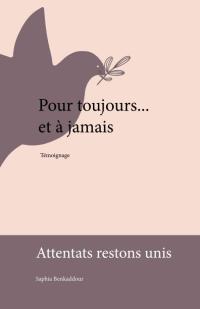
Saphia Benkaddour, Pour toujours…et à jamais, 2021
This book is the story of Saphia Benkaddour: “French and of Algerian descent, I—a woman now 33 years old, a Muslim, a mother, someone who used to spend my vacations in Nice, and a victim of the July 14, 2016, attack,” she writes. In it, she expresses her need to be read, “if not heard by the world.” She adds: “Here you will find my story, written with all my heart and soul, with sincerity and realism, with great sadness as well, but also with gentleness and love, to tell you my true story and that of my son.”
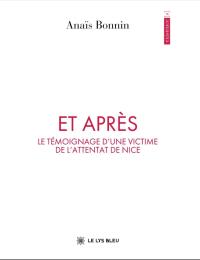
© Le Lys Bleu
Anaïs Bonnin, Et après. Le témoignage d'une victime de l'attentat de Nice, Le Lys Bleu, 2026
July 14, 2016. Nice. How can one summarize nearly ten years of struggle born of a single night that turned everything upside down? These pages reveal the suffering of a fourteen-year-old victim gripped by horror, haunted by a pain that no one sees yet which she is nevertheless required to prove, torn between the desire to forget and the fear of fading from memory. Because while some may appeal their sentences, the victims, for their part, remain condemned to life imprisonment. This account recounts the rage, the courage, and the immense strength required for resilience.
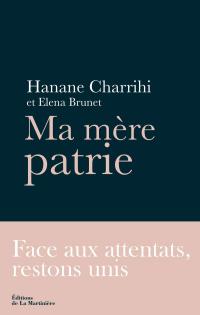
© La Martinière
Hanane Charrihi & Elena Brunet, Ma mère patrie. Face aux attentats, restons unis, Paris, La Martinière, 2017
Fatima Charrihi was the first victim of the Nice attack on July 14, 2016. She was Muslim, as was one-third of those killed that evening. Her daughter, Hanane, reveals the personality of this exceptional mother—a woman who was both demanding and generous, drawing her values of peace and tolerance from her practice of Islam. But Hanane also recounts her grief amid the constant media attention and the hatred her family had to endure while in the midst of mourning. With clarity and gentleness, Hanane takes up her pen to counter generalizations and pay tribute to her mother, reaffirming her attachment to France, her homeland. Hanane Charrihi is 27 years old and lives in the Paris suburbs. She is one of Fatima Charrihi’s seven children. Elena Brunet is a journalist for L’Obs magazine.
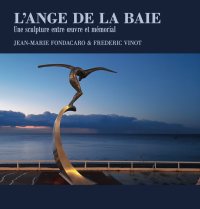
© Langage
Jean-Marie Fondacaro & Frédéric Vinot, L’Ange de la Baie. Une sculpture entre œuvre et mémorial, Maison d’éditions Langage/Université Côte d’Azur, 2026
How can art respond to the collective trauma left in the wake of a terrorist attack? Through a dialogue between sculptor Jean-Marie Fondacaro and psychoanalyst Frédéric Vinot (LAPCOS), this book chronicles the creation of *L’Ange de la Baie*, a memorial installed on the Promenade des Anglais in tribute to the victims of the July 14, 2016, attack in Nice. From the initial sketches to the unveiling, the authors explore the connections between creation, mourning, memory, and urban space, offering a sensitive reflection on the role of art in the face of the unthinkable. Illustrated with previously unpublished documents from the artist’s archives.
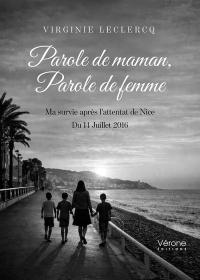
© Vérone Editions
Virginie Leclercq, Parole De Maman, Parole De Femme - Ma Survie Après L'attentat De Nice - Du 14 Juillet 2016, Vérone Editions, 2026
On July 14, 2016, her life came to a halt. Today, Virginie Leclercq recounts how she learned to live again. On the Promenade des Anglais in Nice, in a matter of minutes, everything changed. A day of celebration turned into a scene of horror. But the real struggle began afterward. In this poignant account, Virginie Leclercq takes us into the heart of the aftermath of the attack: the fear that won’t go away, the sleepless nights, the guilt, the children to protect, and that haunting question: how do you go on living when everything has been shattered? Through an intimate account, she recounts the descent into despair, the struggle, and then, slowly, the rebuilding—marked by love and those encounters that save us when everything is falling apart.

© First Editions
Marc Magro (dir.), Soigner. Nice, 14 juillet 2016, First Editions, 2017
Whether they are doctors, nurses, caregivers, firefighters, paramedics, stretcher bearers, secretaries, pharmacists, psychologists, or funeral home staff; whether they were on call, mobilized, or found themselves in the crowd in plain clothes; whether they saved lives, held the hands of the wounded, or counted the dead: the night of July 14, 2016, will remain etched in their memories. Through the words of healthcare workers, this memoir recounts the strengths and vulnerabilities of these men and women, their ability to face the unexpected and tragedy, and to pick themselves up and carry on.
© Saint Honoré Editions
Henrik Moberger, Le diable dans la baie des Anges. Notre combat après l’attentat terroriste de Nice, Saint Honoré Editions, 2021
Henrik Moberger, born and raised in the Värmland region in central Sweden, spent most of his professional life in Gothenburg on the west coast, and later as a journalist with the Volvo Group. He has been a Francophile since his first business trips to France in the 1970s. He developed such a deep love for France and its people that he and his wife, Sassa, both now retired, decided to leave Sweden and settle in Nice. Here, he shares his account of the attacks that plunged the city into mourning on July 14, 2016.
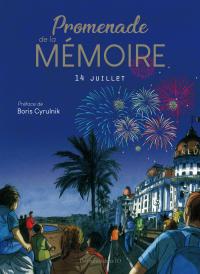
© Des ronds dans l’O éditions
Promenade de la mémoire. 14 juillet, Paris, Des ronds dans l’O éditions, 2020
On July 14, 2016, a truck plowed into the crowd on the Promenade des Anglais in Nice. Six survivors recount the July 14, 2016, attack in Nice through the writing and artwork of Alexis Sentenac, Edmond Baudoin, Céline Wagner, Jeanne Puchol, Joël Alessandra, and Alexis Robin, in collaboration with the Militants des Savoirs association and clinical sociologist Isabelle Seret.
© L’Archipel
Fabien Rajon, Aux côtés des victimes, Paris, L’Archipel, 2022
On the eve of the trial for the Nice attacks, one of the victims’ attorneys shares his story. Representing dozens of victims, Fabien Rajon is one of the key figures in the trial for this attack, which is set to begin in the fall of 2022. Having been involved in other high-profile trials, he offers a behind-the-scenes look at the profession, its strategies, and the means of defense. Through his account of these cases, enriched with personal memories and anecdotes, a vision of the legal profession emerges: a human journey dedicated to serving others, with its successes and failures, but always exhilarating and deeply meaningful. Reflecting on the place our society grants to victims, he offers concrete proposals for the judicial system.
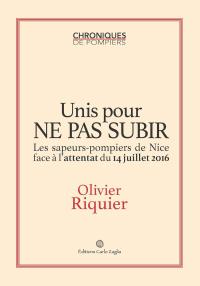
© L’Archipel
Olivier Riquier, Unis pour ne pas subir. Les sapeurs-pompiers de Nice face à l’attentat du 14 juillet 2016, Éditions Carlo Zaglia, 2020
Throughout his career, a COS (commander of rescue operations) prepares for a large-scale civil security crisis. Every stage of a firefighter’s career helps him prepare to face the unimaginable. Lieutenant Colonel Olivier Riquier is one of those who never stop preparing for war, in order to serve better. On the evening of July 14, 2016, in Nice, he would experience the unthinkable. He and his firefighters would attempt to save as many people as possible from an unprecedented attack carried out on the famous Promenade des Anglais. That evening, they stood united so as not to be defeated. This book tells that terrible story. His story! Olivier Riquier is a lieutenant colonel in the professional fire department of the Alpes-Maritimes department. He serves as deputy regional director and is responsible for coordinating the seven companies. He was the commander of rescue operations during the response to the Nice attack on July 14, 2016.
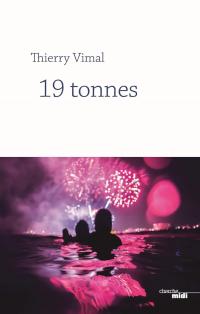
© Editions du Cherche Midi
Thierry Vimal, 19 tonnes, Paris, Editions du Cherche Midi, 2019
On July 14, 2016, the deadly truck plowed through the Promenade des Anglais in Nice, claiming the lives of 86 people, including 12-year-old Amie Vimal. *19 Metric Tons* is the story of a father’s journey to survival in the wake of the tragedy. Thierry Vimal, without pathos or hatred, recounts the aftermath—the heart-wrenching daily life, the black hole that looms every day. Yet, one must find meaning. And carry on... A healing and deeply moving text that explores the human capacity to resist the pull of the worst. Subsequently, Thierry Vimal wrote a series of columns on the first-instance trial of the attack.
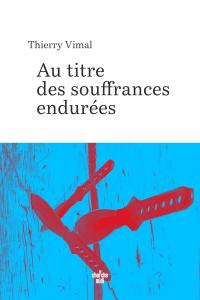
© Le Cherche Midi
Thierry Vimal, Au titre des souffrances endurées, Paris, Le Cherche Midi, 2022
In the form of a novel, the Nice-based writer recounts the painful and arduous journey of the victims of a terrorist attack. At age 14, Emilio survived a terrorist attack and watched his father die in the crossfire. Having dropped out of school and become addicted to video games, he grows up with his mother, Serena, who is bogged down in the endless medical, legal, and compensation proceedings tied to their status as victims. Despite her fighting spirit, she sinks into obsession, despair, and beer. Resentment and unpaid rent pile up. Emilio becomes a disillusioned young man: the so-called support for victims masks a system that excludes them from human society. This is unacceptable: at 19, he wants to take action. From the depths of her despair, can Serena see the dangers threatening her son—hatred, conspiracy theories, radicalization… violence?
Other Resources
- Vincent Brengarth, Défendre l’impossible. Récit immersif d'un procès de justice antiterroriste, Michalon, 2024.
- Eric Galliano, « 14 juillet. Un an d’enquête(s) », Nice-Matin Hors-Série, 13 juillet 2017
- E. Guesnier, « Le regard d’un cadre de santé sur l’organisation des soins le 14 juillet 2016, soir de l’attentat de Nice », Neuropsychiatrie de l’enfance et de l’adolescence, Vol. 65, n°5, septembre 2017, pp. 278-280
- Robert McLiam Wilson, La vilaine veuve. Nice, le procès oublié, Charlie Hebdo Hors-Série, 2023
- Alexandre Schoedler, Nice : l’attentat, la contre-enquête : témoignage et enquête d’investigation d’un rescapé, Sobook, 2021
See also: