

©Claire SECAIL/GIP MM
The appeal hearing in the case of the murder of Samuel Paty
Published on
12th March 2026
updated on
3rd April 2026
Chronicling the trial
For five weeks, from 26 January to 2 March 2026, the Special Assize Court of Paris heard the appeal trial of four men on trial for their role in the murder of Samuel Paty.
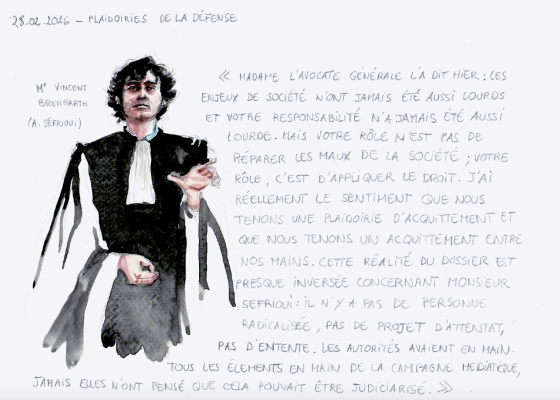
Claire Sécail is a media historian, a CNRS research fellow (CERLIS, UMR 8070) and scientific advisor to the GIP MMT. She is also a talented watercolourist who chose to document the proceedings of the hearing through drawing.
A specialist in media representations of crime and terrorism, she has been working for years at the intersection of legal history, the media coverage of violence and the political dynamics of the French media. The Paty trial lay at the heart of her research areas: an event that was at once terrorist, educational, media-driven and political, whose appeal hearings replayed profound issues surrounding freedom of expression, criminal liability for online hate speech, and the protection of the republican school system.
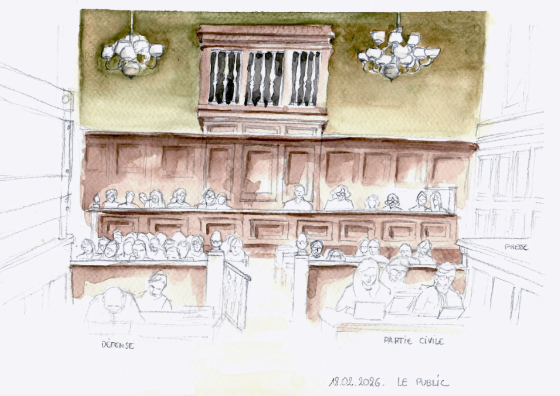
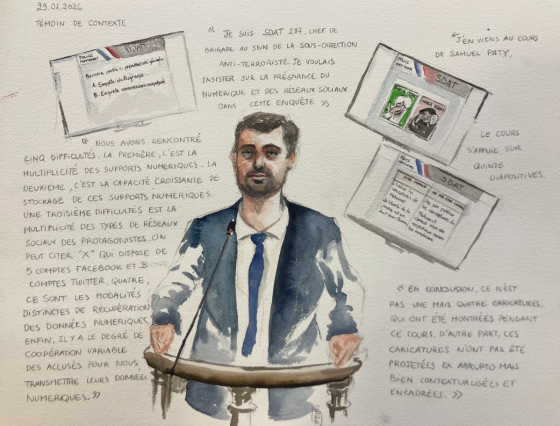
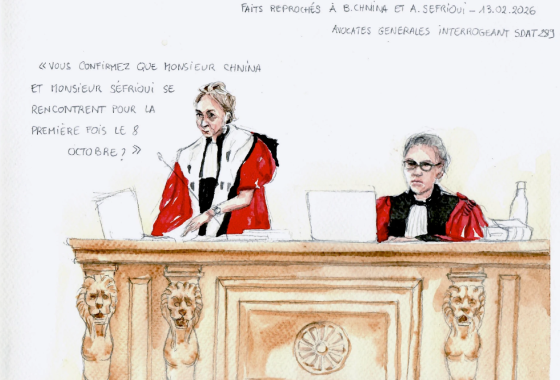
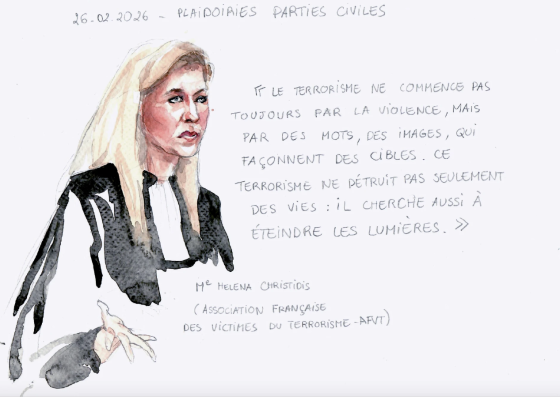
While following in the tradition of courtroom sketch artists, Claire Sécail nevertheless adopts a unique approach: that of a researcher who observes, analyses and seeks to document an appeal trial which, unlike the trial at first instance, is not filmed or archived for posterity. On each day of the hearing, she took out her notebook to transcribe the verbatim records and sketched scenes from the courtroom — the defendants in the dock, the lawyers in their robes, the witnesses on the stand, the presiding judge, and the families in the gallery. These drawings do not seek to faithfully reproduce facial features. They capture an atmosphere, a tension, a gesture, a revealing posture, whilst seeking to convey the substance of the proceedings. They reveal what a journalistic report, however precise, can only hint at.
It was on her Bluesky account that Claire Sécail shared her drawings daily, accompanied by analytical commentary. An original approach that reminds us that the memory of terrorist acts is not built solely in the immediacy of the event, but also — and perhaps above all — in the lengthy judicial process that follows. She demonstrates that a researcher can be present in the public sphere without compromising on rigour, and that unconventional forms of expression — drawing, social media — can serve a need for communication as compelling as that of a book or a scientific article.
It also invites reflection on the role of the gaze in judicial memory: what does it mean to witness a trial? What does it mean to make it visible? How do visual representations of a hearing help to anchor the event in the collective consciousness?
These watercolours will be added to the collections of the Museum-Memorial of Terrorism.
View on Bluesky (in French)
© Claire Sécail / GIP MMT
© Claire Sécail / GIP MMT
© Claire Sécail / GIP MMT
© Claire Sécail / GIP MMT
© Claire Sécail / GIP MMT