

© Olivia Blanquet
The Angel of the Bay, from the studio to the street
Published on
30th April 2026
updated on
23rd June 2026
Interview with Jean-Marie Fondacaro
© Olivia Blanquet
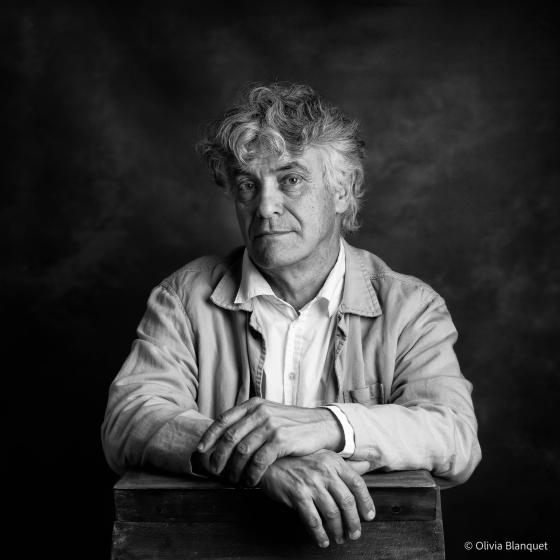
Jean-Marie Fondacaro, a sculptor from Nice, is the creator of *L'Ange de la Baie*, a sculpture installed in 2022 on the Promenade des Anglais in tribute to the 86 victims of the July 14, 2016, attack in Nice. For the Museum and Memorial of Terrorism, he reflects on the creative process behind this sculpture—from the urgency in the aftermath of the attack to its public installation—and on what it means for an artist to respond to a commission for a memorial and commemorative work.
Can you describe L’Ange de la Baie to us?
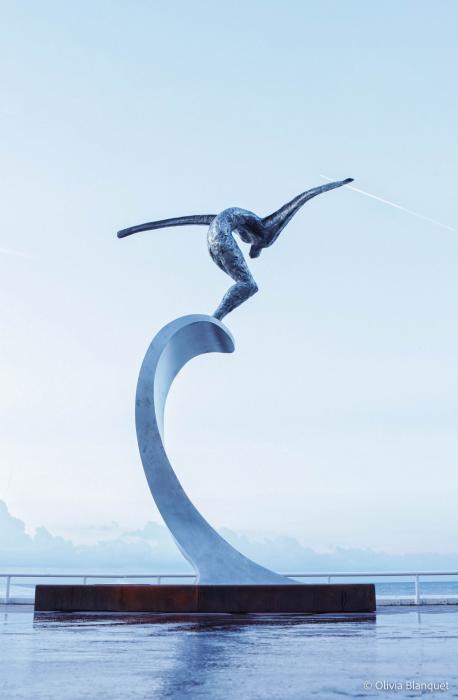
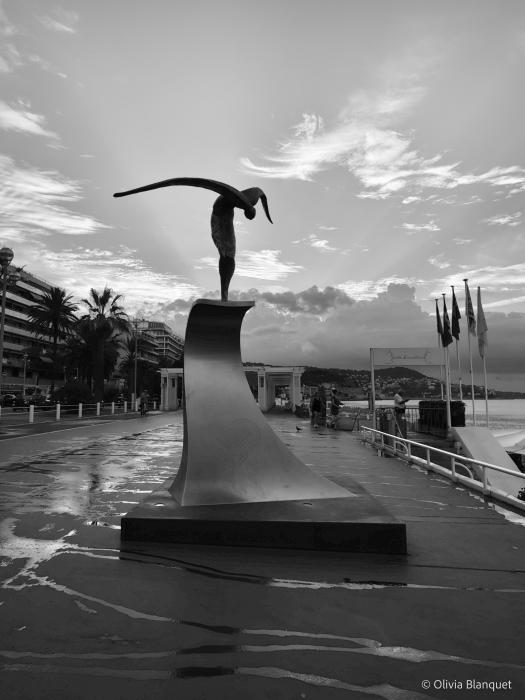
The work rests on a Corten steel base, whose reddish-brown hues blend into the asphalt of the Promenade des Anglais. The idea was for this base to disappear visually, so that only the wave and the soaring figure stand out at first glance. The sculpture is 4.60 m tall with a wingspan of 3.50 m.
Rising above this base is a large wave made of welded aluminum—6-mm-thick plates twisted into a spiral using industrial rolling machines, a process of great technical complexity. This wave was oriented perpendicular to the sea, facing the truck’s path, like a bulwark erected against its reckless rush.
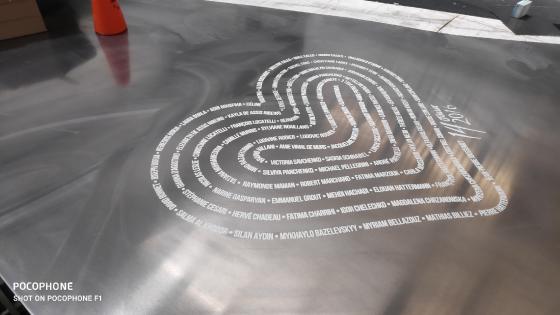
Above the wave, the “Takeoff”—a cast aluminum piece—soars toward the horizon while casting its gaze toward the heart engraved in the hollow of the wave, on which are inscribed the names of the 86 victims who died. This tension between the horizon and the heart lies at the heart of the piece’s symbolism.
You’ve said that the day after the attack, you took refuge in your studio to create—an act you describe as a cry of pain, with no intention of commemorating the event. How did the shift occur from this intimate sculpture to the public work that is now L’Ange de la Baie?
Like everyone else, I was in shock. Everyone reacts in their own way. We artists have this ability to find joy in the material itself. The next day—or perhaps even the very same day; it’s a bit fuzzy—I was in my studio and began working on plaster “bouquets of flight,” a reference to my signature work. It wasn’t conceived as a monument at all. For me, it was a cry of pain cast in clay.
The turning point came with the call for proposals. And that’s when everything changed. Between a work created in the privacy of my studio and a piece intended for the public space—in that specific location, involving the victims’ families, the organizations, and the City—many questions suddenly arose. I started from scratch.
The first thing I read in the specifications was the letter from the presidents of the victims’ associations, explaining why they wanted this monument. And then there was the heart bearing the victims’ names, which was to be part of the work; I’d never really seen it before. I began reading the names, one by one—surnames repeating side by side. That’s when I truly grasped the depth of the tragedy, and that image stayed with me throughout the entire creative process.
What was your inner process when you were conceiving L'Ange de la Baie? How do you approach a commission, and how do you artistically tackle the creation of a work paying tribute to the victims of a terrorist attack—balancing the need to bear witness with the risk of re-enacting the unbearable?
It’s true that for an artist, working for oneself is different from working for others.
Personally, I enjoy commissions. It’s a balance between the challenge of meeting the commission’s requirements while remaining true to my vision as an artist.
I’ve always sought to explore life, emergence, the tensions between materiality and verticality—and perhaps spirituality—but above all, elevation. And in this case, I felt I was confronting the central theme of my work.
My initial intention was clear: I wanted pain to be present in the work, but I didn’t want it to be violent or shocking at first glance. I wanted to speak of life, to create something that reaches toward the horizon, toward the future—something that breaks free and rises.
At the same time, the heart—with those names—had to be present, a requirement specified in the call for proposals. The idea of the angel’s gaze bent toward the heart came to me fairly quickly; that suspended gesture, like a final glance—or rather, a permanent gaze, since the sculpture remains frozen in its movement. And then I wanted the piece to be in harmony with its surroundings, not jarring. Not to please, but because I thought that harmony could reach a wider audience—people not directly affected by the attack—who would approach the sculpture out of curiosity and then discover its deeper meaning.
L’Ange de la Baie seems to invite multiple interpretations: a figure of mourning and protection, a symbol of diving and taking flight, but also an evocation of the sea and the curves of the bay. Did you intentionally create this polysemy, or did the work itself unfold its layers of meaning? Is there an interpretation you hadn’t anticipated?
For me, a work of art cannot have just one level of interpretation. The heart is the first level—the most obvious, the most accessible. But beyond that lies everything that will touch something sensitive within people, whether they are directly affected or not.
The curves of the piece, for example; I conceived them to resonate with the curves of the Baie des Anges. The wave extends the bay, and the upward sweep, depending on the angle, turns toward the airport, toward the west of Nice. All of this was part of my exploration of beauty and integration into the site.
But the thing I hadn’t anticipated—what I now call the missing piece—is that as passersby lean in to read the victims’ names, they form a heart. In the initial stage of creation, I had indeed planned a double wave forming a heart. When I added the soaring form above it, I realized I could remove half of the heart so as not to be stuck with a closed-off vision. And it was only much later that I understood: I had removed what had been torn away from the families. Seeing that heart reunited was a very powerful revelation for me. That’s one of the gifts of the creative process—it comes from a place I don’t fully control.
The choice of material in a memorial work is never trivial. Why aluminum and Corten steel? Did they carry a particular meaning from the start?
First, there were very practical constraints. The sculpture had to be self-supporting; it was impossible to anchor it to the ground on the Promenade. With a sail-like shape that catches the wind, the first step was to consult a materials engineer to calculate the structural loads. Aluminum was the obvious choice because of its lightness: the wave and the soaring element weigh no more than 300 kilos. Inside the Corten steel base, however, I inserted cast-iron weights to counterbalance the wind load. If I had made the entire piece out of bronze, the weight would have tripled.
But beyond the technical considerations, Corten steel had a deeper meaning. Once oxidized, it sets, it stabilizes, and it doesn’t corrode. Its reddish-brown color, very similar to the asphalt of the Promenade, allowed the base to blend into the background. And the aluminum evokes lightness and elevation. The wave is heavy in its symbolism but light in its material. That’s also what gives the piece that sense of suspended movement.
L’Ange de la Baie stands where the tragedy occurred, transforming the site of the attack into a memorial space in its own right. What role do you assign to a work of art in such a space? Does it offer something that architecture, historical records, or eyewitness accounts cannot provide on their own?
For me, a work of art is not a piece of furniture. It has a responsibility toward the place, its memory, and its harmony. My main focus is integration: a sculpture must be exactly where it’s meant to be, resonating with the place without taking up all the space. It must take its place, but not all the space.
What’s unique about a memorial space is that it speaks to several audiences at once: the families of victims, passersby, and tourists who know nothing about it. The artwork can bridge that gap; it first catches the eye for its own sake—for its form and movement. And then, as you get closer, you realize there’s something else going on. It speaks to a broader audience than a traditional monument would.
What art brings—and what documents or architecture alone cannot provide—is perhaps this: the ability to speak of the unspeakable without freezing it into a single meaning. Today, I have distanced myself from the artwork, which now belongs to passersby and the families.
*
Jean-Marie Fondacaro has co-authored a book with Frédéric Vinot—a senior lecturer in clinical psychology at the Université Côte d’Azur and a psychoanalyst in Nice—on the creative process in relation to the grieving process. The book is scheduled for publication by Langage in the summer of 2026.
© Olivia Blanquet
© Olivia Blanquet
© Olivia Blanquet