

© GIP MMT
The Role of Trauma in Society and at the Memorial and Museum of the Terrorism
Published on
4th June 2026
updated on
23rd June 2026
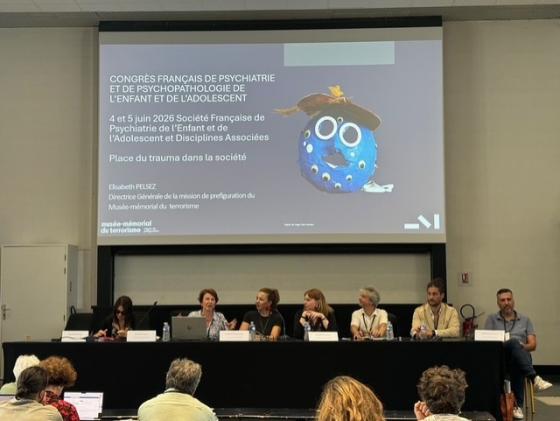
Presentation by Elisabeth Pelsez at the Annual Conference of the French Society of Child and Adolescent Psychiatry (SFPEADA) – Nice, June 4, 2026
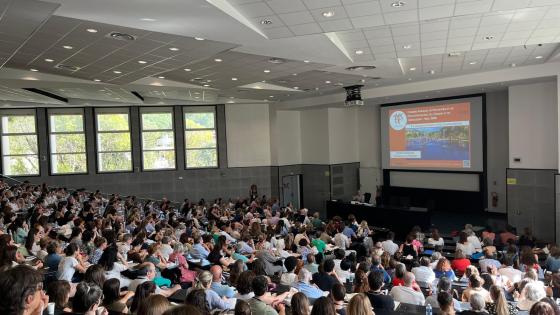
On June 4, 2026, during the annual conference of the French Society of Child and Adolescent Psychiatry and Related Disciplines (SFPEADA), held in Nice (in tribute to the victims of the July 14, 2016, attack) on the theme Child and Adolescent Psychiatry and Trauma, Elisabeth Pelsez, Executive Director of the preparatory mission for the Museum and Memorial of Terrorism, spoke at the symposium dedicated to the role of trauma in society.
Alongside representatives from the association France Victimes, two Medical-Psychological Emergency Units (CUMP), the Nice-based association Une Voix des Enfants, and the federation Victim Support Europe (VSE)*, she offered the unique perspective of a memorial institution currently under construction, at the intersection of memory, knowledge, and recognition of victims.
* The France Victimes association, the Une Voix des Enfants association, and the Victim Support Europe (VSE) federation are members of the MMT’s Advisory Board. Also participating in this conference was Lise Eilin Stene, a professor of medicine and research associate at the Norwegian Centre for Violence and Traumatic Stress Studies (NKVTS) in Oslo, who is also a member of the MMT’s Scientific and Cultural Council.
The MMT: A Space That Will Give Trauma Its Rightful Place
Elisabeth Pelsez began by outlining the context of the future Museum and Memorial of Terrorism, scheduled to open in 2031. Approved in 2018 as part of a coherent and comprehensive memorial policy in support of victims of terrorism, the MMT will trace more than fifty years of terrorism’s history on French soil and abroad—in all its forms: jihadist, far-right, far-left, regionalist, or state-sponsored terrorism.
Three major themes will structure the permanent exhibition: the history of terrorism, society’s response, and the voices of the victims—the latter serving as the central thread throughout the entire project. At the heart of this approach is the aim to illustrate the long-term trauma inflicted by terrorism on society and how the collective perception of this trauma has evolved.
Bringing Trauma to Life:
The Voices of Victims and First Responders
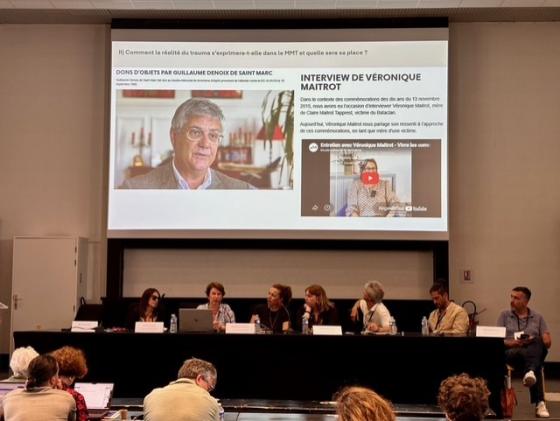
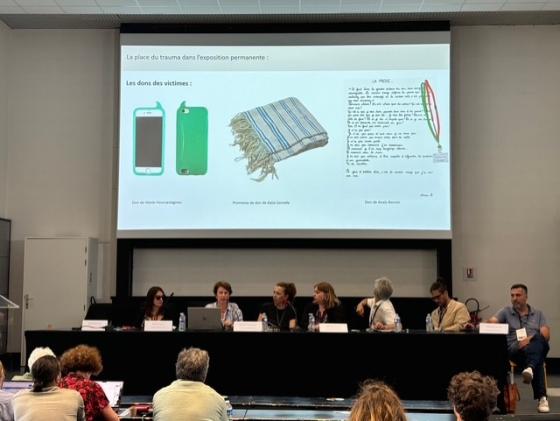
The permanent exhibition will strive to embody the reality of trauma through firsthand accounts (videos filmed with victims, or objects donated by survivors, victims’ loved ones, and institutions) as well as through artistic creation, a powerful medium for narrating trauma: a mask made by a child who transformed her fear into a superpower, a painting created by a survivor to process the trauma, or artwork by students that demonstrated how deeply affected they felt by terrorism within their school or simply within society.
Trauma does not affect only the direct victims. Elisabeth Pelsez also discussed the emphasis placed in the MMT on the vicarious trauma experienced by first responders, particularly Paris firefighters. Documented through nearly 700 collected testimonies, this finding aligns with other international examples, such as that of New York City firefighters after September 11.
Society in the Face of Trauma:
Scientific, Judicial, and Artistic Resilience
The presentation also highlighted how societies react and transform in the face of terrorism. Thus, the MMT will address, in particular:
- the role of the scientific community through major research programs on psychotrauma, including the work conducted in Nice by Florence Askenazy (Lenval Foundation) or in Norway by Lise Stene, and the creation of the National Center for Resources and Resilience (CN2R);
- the role of schools—shaken but resilient—illustrated, for example, by the mural created by artist Vissou in tribute to Samuel Paty;
- the period of trials—a moment of both individual and collective confrontation with trauma, amplified by media coverage of testimonies;
- and the artistic community—from Bono to Vincent Delerm, including Adel Abdessemed—which has helped preserve and extend the memory of the attacks.
Beyond Trauma:
Paths to Reconstruction
Elisabeth Pelsez concluded her remarks by highlighting the fundamentally forward-looking nature of the memorial project. The MMT aims to highlight the paths to recovery, particularly once the legal process has concluded, as well as examples of collective resilience such as the monument on the Promenade des Anglais in Nice, the participation of survivors in the ceremonies at the Paris Olympic Games, and the Garden of Remembrance in Paris honoring the victims of November 13.
This presentation illustrates the mission of the future Museum and Memorial of Terrorism: to be not only a place of remembrance and knowledge, but also a space for dialogue open to the scientific, medical, and social communities, both in France and internationally.
The MMT particularly appreciated being involved in the discussions led by psychiatrists and child psychiatrists on understanding the connection between individual and collective trauma—a connection it will strive to convey as accurately as possible in its permanent exhibition.
A video of the discussions will be available soon.
© GIP MMT
© GIP MMT
© GIP MMT
© GIP MMT