

© Jeu de Paume
Images of 9/11: Understanding an event through its photographs
Published on
12th October 2026
updated on
12th October 2026
© Say Who /Astrid Staes /2023
Clément Chéroux has been Director of the Henri Cartier-Bresson Foundation in Paris since 2022. He was previously Chief Curator at MoMA in New York (2020–2022), Senior Curator at the San Francisco Museum of Modern Art (2017–2020), and Curator and then Head of Department at the Centre Pompidou (2007–2016). He is a photography historian and holds a PhD in art history. He has curated numerous exhibitions and has published, as author or editor, more than fifty books on photography and its history.
To mark the 25th anniversary of the attacks of 11 September 2001, the photography historian reflects on his book Diploplie. The Photographic Image in the Age of Globalised Media: An Essay on 11 September 2001 (in French only), which is devoted to the photographic coverage of the event and has been republished to mark the occasion. He explains how these images became iconic, why only a few photographs have become ingrained in the collective memory, and what they reveal about our relationship with images and history.
MMT - How did you come to work on the images of 11 September?
La source média référencée est manquante et doit être réintégrée.
Clément Chéroux - I became interested in the images of 9/11 on 9/11 itself. At the time of the attacks, a colleague rang me to tell me that the World Trade Centre towers had just been struck. I was at Place de la République in Paris when I noticed, in the window of an electronics shop, around ten screens simultaneously showing the same images. That initial experience was formative: even before I had a chance to reflect on the event, I was struck by the visual repetition of those images.
Very quickly, I began collecting the daily newspapers, weekly papers and magazines published in the days following the event. My aim was not to collect objects, but to build up an archive on this subject that did not yet exist anywhere else. This documentation thus became the first step in my research.
This subject also ties in with questions that were already running through my work. For several decades, I have been interested in photography in all its diverse forms: artistic, documentary, media and vernacular photography. The attacks of 11 September 2001 offer an exceptional field of observation for understanding how images circulate, are repeated, acquire symbolic value and ultimately shape our collective memory.
The book Diploplie. The Photographic Image in the Age of Globalised Media: An Essay on 11 September 2001 is thus the result of several years of research. A postdoctoral fellowship at Princeton University in 2004 enabled me to explore the earliest American academic work on the media coverage of the attacks. Then, during a residency at the Villa Medici in 2005, I revisited all the material I had gathered to develop a historical analysis of this event, which had, almost instantly, become a global visual phenomenon.
MMT - How did you compile and analyse your corpus of images?
Clément Chéroux - The book is based on a simple idea: before interpreting the images, I first had to observe what had been published. I therefore compiled a corpus of hundreds of front pages from US, French and international newspapers and magazines, supplemented by press agency archives available in the United States.
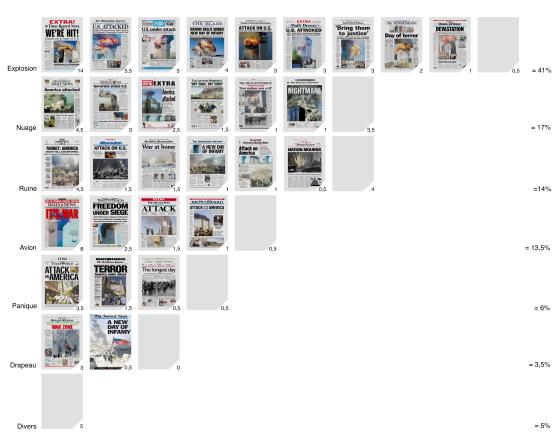
Using this collection, I carried out a very simple but decisive statistical analysis. The aim was not to produce a sophisticated quantitative analysis, but to gauge which types of images appeared most frequently. The result is striking: nearly 95 per cent of the American front pages published on 11 and 12 September were based on just six standard images.
The same motifs recur time and again: the second plane hitting the South Tower, the gigantic cloud of smoke following the collapses, people fleeing through the streets of Manhattan, the ruins of Ground Zero, and firefighters raising the US flag.
It is from this observation that the book’s central question arises. 9/11 is probably the most photographed and filmed event of its time, yet it is also the one we have come to remember through an extremely limited number of photographs. This paradox lies at the heart of my approach: to understand why such a profusion of images results in such a limited visual memory.
© Clément Chéroux