

© GIP MMT
New York, 25 Years Later: At the Heart of the 9/11 Commemorations
Published on
16th September 2026
updated on
24th September 2026
Report by Elisabeth Pelsez, Executive Director of the MMT.
It was a week filled with emotion, shared memories, and images coming back to mind, marked by the phrase everyone kept repeating: “25 years already.” Everyone recalled exactly where they were and what they were doing on September 11, 2001: time seemed to stand still, so unforgettable is that historic moment.
We experienced these commemorations alongside Kari Watkins, director of the Oklahoma City Museum, and Lena Fahre, director of the July 22 Center in Oslo, in a spirit of solidarity with the 9/11 Memorial & Museum, the driving force behind a series of events that its director, Cliff Chanin, was keen to have us participate in.
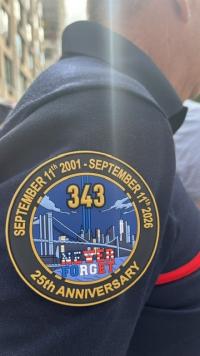
The firefighters’ march, in tribute to their 343 colleagues
© DR
From Sunday 6 September, a march organised by the New York Fire Department, setting off from the Church of St Francis of Assisi, paid tribute to their 343 colleagues who died in the collapse of the Twin Towers, not forgetting the 60 members of the police force who were also lost.
During stops outside several of the city’s fire stations, the names of the victims were read out; between stations, a huge bell, mounted on one of the vehicles driven by trainee firefighters, rang out. Throughout the procession, a special tribute was paid to the fire service chaplain, the Franciscan Father Mychal Judge, regarded as the first victim of the tragedy: present in the North Tower at the time of its collapse, he was killed by a piece of steel debris that snapped his neck. Venerated by the fire service, his remains were carried by rescuers to St Patrick’s Church; his memory, associated with a life dedicated to serving others, remains extremely vivid.
Among the large and solemn crowd were around twenty French firefighters who had come in solidarity with their New York colleagues, some of whom had established partnerships even before 2001 — a collaboration that has continued to grow ever since. To bring the march to a close, Sébastien Frémont, lieutenant-colonel and head of the prevention service at ENSOSP, presented a French firefighter’s helmet to Lillian Bonsignore, 37th Fire Commissioner of the New York Fire Department, who was appointed to lead the organisation by the mayor last January. On 11 September 2001, she was already involved in the rescue efforts for the victims from the very first moments.
A charity dinner hosted by Michael Bloomberg
On 9 September, a fundraising dinner brought together 1,000 people with Michael Bloomberg, the current chairman of the board of trustees of the 9/11 Memorial & Museum. As mayor of New York from 2002 to 2013, he witnessed every stage of the city’s reconstruction: the Ground Zero museum project, which opened its doors in 2014 following the inauguration of the Memorial in 2011. Many members of the board of trustees lost a loved one in the attacks. Artists such as Bette Midler and Denzel Washington lent their support to the cause, calling for the memory to be kept alive and for each guest to make a financial contribution. The 9/11 Museum is, in fact, funded primarily by patrons, as well as through ticket sales.
« In their honor », an exhibition characterised by restraint
© GIP MMT
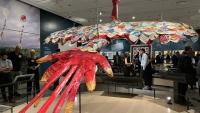
That same week, the opening of the exhibition marking the 25th anniversary at the museum offered a journey back in time. Entitled ‘In Their Honour’, it is designed to be understated and restrained, based on carefully selected personal accounts that reveal what has become of the first responders, as well as the first aiders who devoted themselves to helping the victims on the day of the attack and in the years that followed. The meaning they have given to their lives — centred on altruism, service and commitment to the community — is powerfully highlighted, reflecting each individual’s determination to defy fate and rise again.
The decisive choices recounted are countless: keeping a father’s memory alive by becoming a firefighter in turn; passing on knowledge by becoming a teacher; maintaining networks of solidarity across the country and around the world; creating works of art in memory of the tragedy. Feeling strong and alive by serving the community, whilst refusing to accept fate. At the centre of this room – relatively modest in size but entirely conceived by the museum’s teams (including the design; only the production work was outsourced to external contractors) – stood a vast phoenix composed of drawings by orphaned children who had spent years at a summer camp. Each feather corresponded to an individual artwork; a digital display allowed visitors, for each drawing, to discover the face of the child who had created it, their story, and then their appearance as an adult, accompanied by a description of their current involvement. A true ode to rebirth, this immense bird—colourful, powerful and fragile all at once—left visitors awestruck. Light-coloured, rounded, oblong wooden seats allowed groups to gather together in front of the artwork, just as those who had helped to create it had done.
11 September 2026, by the memorial pools
© GIP MMT
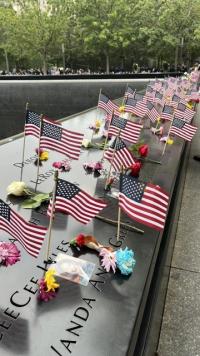
On 11 September 2026, at precisely 8.46 am, the commemoration began on the vast esplanade surrounding the two pools carved out on the very spot where the Twin Towers once stood. At that very hour, twenty-five years earlier, the first aeroplane had struck the North Tower; shortly afterwards, a second had targeted the South Tower. A bell toll, accompanied by a minute’s silence, marked these tragic moments, as well as the two other attacks that took place in Washington, at the Pentagon, and in Shanksville, Pennsylvania, where the fourth plane had crashed. The collapse of the first and then the second tower was marked by the same ceremony, which was interspersed with the reading of the 2,977 names by the families, lasting around four hours.
The presence of several former US presidents and their wives — Bill Clinton, George W. Bush, Barack Obama and Joe Biden — along with Vice-President JD Vance and the Mayor of New York, Zohran Mamdani, underlined the exceptional nature of this 25th anniversary. Everywhere, family members wore personalised T-shirts bearing the names of the deceased on the back; they placed a flower, a teddy bear or a personal item in the spaces between the names engraved on the parapets of the pools. The emotion was intense and palpable. Twenty-five years is the span of a generation: many children were paying tribute to departed grandparents whom they had never had the chance to meet.
There were no official speeches from representatives of the US government or the City of New York, but the crowd was deeply attentive and moved. American commemorations differ profoundly from those we are familiar with in France: at this highly secure site, families wander constantly, embrace one another, gather together whilst the names are being read out, and rarely stand still. The atmosphere is one of movement and resilience; gestures of solidarity are constantly on display, without obscuring certain tensions: some voices praised President Trump’s actions, whilst others spoke out against governments that had shielded Saudi Arabia, which several families accused of complicity in the deadliest attacks the United States has ever experienced.
An educational programme attended by 1.7 million teachers
© GIP MMT
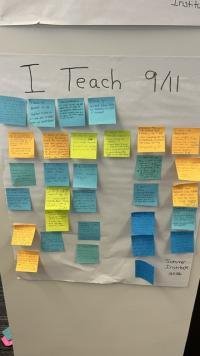
On the same day, as happens every year, an online educational programme was held, led by around twenty members of the museum’s education department. 1.7 million teachers had registered for it, the majority of whom were American, but some were also from abroad — notably from France, as several classes from the Paris Region were also taking part online.
The questions asked often centred on whether or not the museum’s presenters had been at the Twin Towers on the day of the attacks — which was rarely the case, as most of them were too young to have experienced the events. Their preparation for this rapid-response exercise, conducted in an almost uninterrupted stream, reflects the high standards of the museum: ready-made answers and reference figures were kept on hand to address the majority of questions, whilst hashtags linked to more comprehensive documentation. Whenever an entirely new question arose, all the respondents would consult with one another to provide the best possible information.
Greater legitimacy for the FRENCH museum and memorial
The commemorations of this ‘world event’, observed across the globe, have helped to keep the memory alive, despite the revisionist and conspiracy theories that have, once again, resurfaced. The reality of the death toll, as well as that of the thousands of people who have since died from inhaling metal-laden dust from the rubble, cannot be forgotten. The accounts of the countless physical and psychological injuries remain etched in every individual’s memory and, even more so, in the collective memory of our world; they are inscribed in history.
Taking part in these commemorations lends all the more legitimacy to the project for a Museum and Memorial of Terrorism in France: it is our duty to pass on to all future generations not only how terrorism has profoundly scarred our societies, but also how these societies have been able to draw on their humanity to rebuild themselves.