

© DR
Testifying to the terrorists attacks in contemporary Spain
Published on
5th October 2026
updated on
5th October 2026
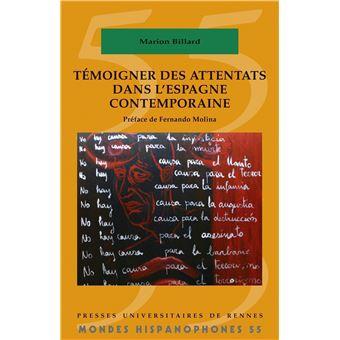
Interview with Marion Billard to mark the publication of her book "Testifying to the terrorists attacks in contemporary Spain" (Presses universitaires de Rennes, 2026, available in French only). Marion Billard is an associate professor of Spanish and holds a PhD in Hispanic Studies from the Sorbonne Nouvelle University. She is publishing here the results of her doctoral research. The book received support from the Museum and memorial of Terrorism.
© DR
MMT - Your book, based on your doctoral research, analyses published accounts of the ETA and Islamist attacks carried out in Spain since the 1970s. Your analysis focuses on the accounts of victims (both direct and indirect), as well as those of terrorists, journalists and, on occasion, members of the public. Could you explain why you chose this approach and what this ‘mosaic of testimonies’, as you call it, reveals about the place of the event in individual and collective memory?
Marion Billard - I felt that adopting a comparative approach was essential in order to reconstruct the terrorist event (attack) as accurately as possible. I focused on published testimonies because these have the distinctive feature of recounting an event through the experience of an individual. Very numerous since the year 2000, they may result from an individual initiative (a victim or a terrorist decides to publish their account), a collective effort (an association of victims, a victim in an institutional role, or a witness undertakes the task of collecting testimonies), an editorial initiative (a publishing house contacts a participant directly to ask them to share their experience) or a journalistic initiative (one or more journalists propose an investigation into one or more attacks based on personal accounts). All these approaches, with their different aims, place the individual at the centre of remembrance. This remembrance thus represents a unique and singular perspective on an event that is, initially, experienced in person. Consequently, this subjectivity of the event calls for other perspectives to be incorporated in order to provide a narrative that aims to be comprehensive.
The plurality of authors allows us to examine the status of each individual in order to define what I refer to in the book as a ‘witness sphere’. I have thus excluded the terrorists because – and this is one of the key insights of this comparative approach – the temporality of the event is radically different in the accounts of the victims and those of the terrorists. Whilst the aftermath of the attack takes centre stage in the victims’ narratives, conveying the profound upheaval in their lives caused by the deadly event, in the terrorists’ accounts the period leading up to the attack is detailed through a sequence of actions intended to follow a logical progression, in order to explain the inevitable act itself. Whilst the former bear witness to a crime suffered, the latter confess to the planning and perpetration of the crime committed. It is therefore necessary to analyse the discursive mechanisms underlying all these accounts, for once they are brought into the public sphere, they acquire, amongst other things, a political, social and educational significance that contributes to the formation of a collective memory of these events.
MMT - Your book aims to show that, through the act of storytelling, there are points of contact between the experiences of ETARR and Islamist terrorism. What are the salient features of the narratives you have studied in the case of contemporary Spain? More broadly, through your comparative approach, have you observed any differences or similarities depending on the period, the status of the witnesses or the types of terrorism?
Marion Billard - A clear distinction must be made between the accounts of victims and witnesses on the one hand, and those of terrorists on the other. Furthermore, whilst there are numerous testimonies from ETA terrorists, this is not the case for Islamist terrorists, most of whom carried out suicide attacks (Madrid, 11 March 2004) or engaged in deadly confrontations with the police (Barcelona and Cambrils, 17 and 18 August 2017). We therefore have access here to the accounts of accomplices or relatives.
Whether they relate to ETA terrorism or Islamist terrorism, the victims’ accounts follow a similar structure. All describe a sense of bewilderment in the face of the event, followed by a moment of realisation that brings about a major upheaval in their lives. Emotions run high. Sometimes the trauma has not yet been overcome or leads to dissociation at the time of recounting the story. When they manage to begin the process of rebuilding their lives, this often takes the form of action: setting up an organisation, becoming involved in legal proceedings, or passing on their memories.
All the terrorists’ accounts refer to a sense of alienation and a lack of free will at the time of the events, which serves to depersonalise the crime and absolve the perpetrator of responsibility. This stance is problematic given that, to date, more than 300 ETA attacks remain unsolved.
Despite the points of similarity, a recurring difference can be observed. Whilst Islamist terrorists are regularly dehumanised in a way that excludes them from the community, ETA terrorists always appear to remain part of the social fabric against which they carry out their attacks.
A long-term analysis has highlighted a major shift in the relationship between society and the victims of terrorism. When ETA carried out attacks, a significant section of society looked the other way, or even justified its crimes with the phrase ‘Algo habrá hecho’ (‘He must have deserved it’). In the hours following the Madrid bombings of 11 March 2004 (11-M), condemnation was unanimous. The victims of terrorism were no longer merely the individuals directly targeted by the terrorists, but an entire city, a country, and the international community. Following the attacks in the United States (2001), Spain and its people expressed a shared sense of grief. Islamist terrorism has substantially altered the way terrorist events are framed, shifting them from a personal or family experience belonging to the private sphere to a collective experience belonging to the public sphere.
MMT - Your book forms part of the dynamic field of academic research into the representation of the terrorist experience, which has expanded significantly since the 11 September attacks. How does the Spanish case fit into this broader context?
Marion Billard - The Spanish case is particularly interesting in that ETA’s terrorism had a continuous and very sustained impact on society from 1968 to 2011. Although it was not until the kidnapping and subsequent murder of the local councillor Miguel Ángel Blanco in July 1997 that there was a categorical social condemnation of terrorism, collections of ‘ ’ testimonies, academic research and journalistic investigations into the experience of terrorism had been published before the emergence of Islamist terrorism in the United States, as I point out in the first part of the book. Very early on, discussions emerged in Spain regarding how to narrate the ETA terrorist experience (attacks, extortion, kidnappings, urban violence, harassment). These explored, for example, trauma and how to move beyond it, forgiveness, and also the reintegration of ETA terrorists. In this respect, it seemed essential to me to draw parallels between accounts of ETA and those of Islamist attacks, given that, in the Spanish context, this underlying connection cannot be ignored.
MMT - You sometimes draw parallels with accounts relating to the attacks carried out in France in January and November 2015 to support the idea of a transnational dimension to the narratives that emerge following a terrorist event. Could you elaborate on this point?
Marion Billard - The transnational dimension can be observed at two levels in the accounts. On the one hand, these accounts are themselves increasingly embedded within a global history of the terrorist experience, in which individual suffering is linked to contemporary, past or future collective upheavals that extend beyond the borders of the country targeted by an attack. I discuss this in the book using examples drawn from Spanish testimonies, but the same applies to testimonies published in France. *Le lambeau*, an account by Philippe Lançon, a survivor of the attack on the *Charlie Hebdo* editorial office, ends on 13 November 2015 whilst he is in New York, ‘not far from the place where, on 11 September 2001, the locomotive had once again run out of control’ and as he learns that an attack is taking place at the Bataclan. For his part, Christophe Naudin recounts in his *Journal d’un rescapé du Bataclan. Être historien et victime d’attentat* the upheaval caused by the attack in Barcelona on 17 August 2017.
Furthermore, there are recurring patterns in the writing and themes. Like many victims of attacks carried out in Spain, Catherine Bertrand, a Bataclan survivor, acknowledges in her graphic account *Chronicles of a Survivor* that she found it ‘very difficult to accept the status of victim’. Patrick, a survivor of the Nice attack, states that he was born on that very day in the collection of graphic testimonies *Promenade de la mémoire. 14 juillet*. Finally, Ramón González, a Spanish survivor of the Bataclan attack, emphasises in his testimony *Paz, amor y death metal* the key role of writing in his therapeutic process.
All these accounts weave together a tapestry of memory that extends far beyond the single terrorist event that prompted the testimony. The proliferation of attacks in various European cities, targeting individuals of diverse nationalities, has given rise to a transnational memory of the terrorist experience that I have termed ‘terror-historical memory’.
MMT - You carried out part of your research at the Memorial Centre for the Victims of Terrorism in Vitoria-Gasteiz, a partner of the Museum and Memorial of Terrorism. What is it like to work as a researcher within a museum and memorial institution, and what did you take away from this experience?
Marion Billard - The Centre in Vitoria-Gasteiz did indeed welcome me on two occasions, in 2021 and 2022. I spent most of my time there in the library, which was not yet officially open but which already offered numerous resources that I would not otherwise have been able to access. During these two visits, I was also able to discuss matters with three of the Centre’s managers: Gorka Angulo Altube, Gaizka Fernández Soldevilla and Raúl López Romo. Their expertise enabled me to refine my understanding of the challenges involved in memory work on terrorism within the Spanish context. Moreover, the fact that the Centre brings together this ‘research’ hub and the museum space under one roof gave me the opportunity not only to take the time to analyse the proposed memorial tour but also to take part in a guided tour for a group of French schoolchildren.
Another organisation, the Madrid Railway Museum, also welcomed me during my research. There too, I was able to rely on the archivists’ assistance to access unpublished documents forming part of the ‘Archive of Mourning’, dedicated to the 11-M attacks.
The work carried out at the Centre in Vitoria-Gasteiz is fundamental and invaluable, as it enables a practical link to be forged between memory policies, scientific research and the work of remembrance. Thanks to this centre, the process of transmission takes on its full meaning.
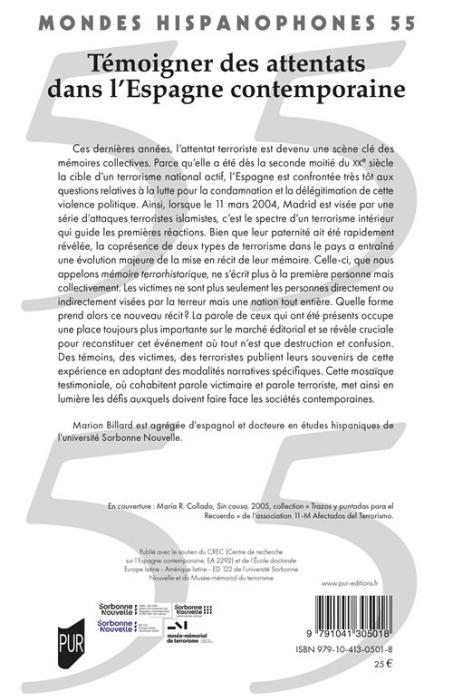
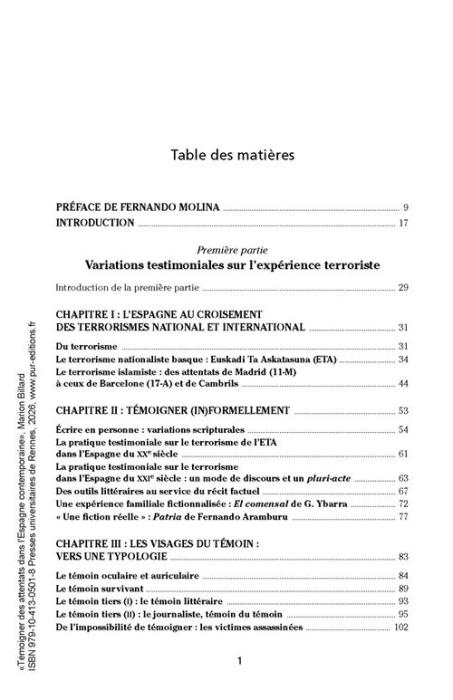
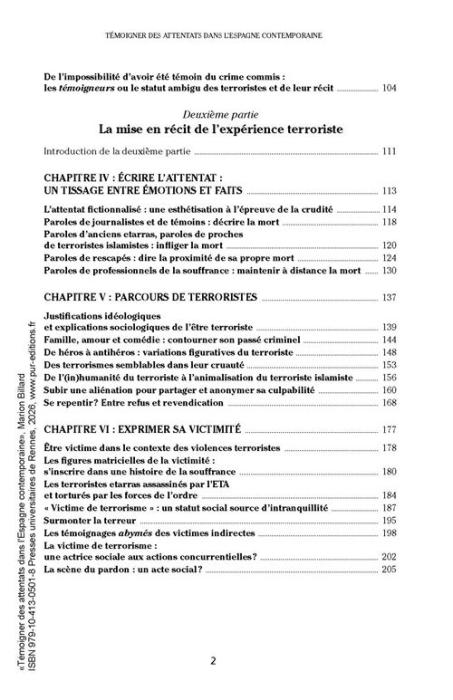
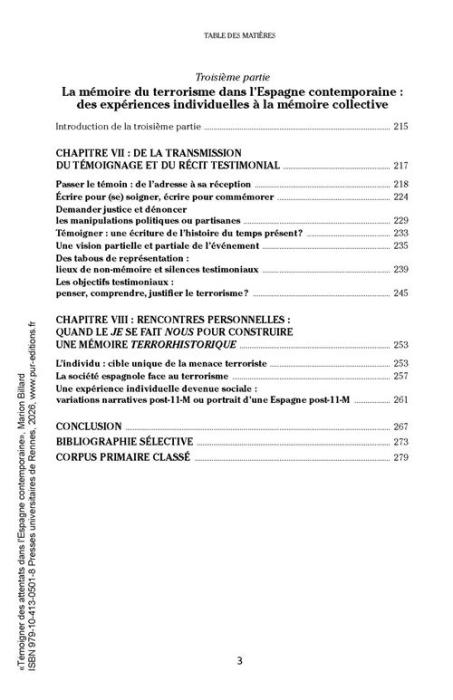
See abstract and table of contents below (in French only)
© DR
© DR
© DR
© DR