

© GIP MMT
How can we teach students about the history of terrorism in the classroom?
Published on
1st July 2026
updated on
6th July 2026
As part of Theme 3, “History and Memories”, of the HGGSP track, the Museuam and Memorial of Terrorism (MMT) guided senior students from the Marie-Curie High School in Sceaux and their teacher in a discussion of terrorism, approached from the perspectives of history, memory, and justice. his educational program was organized into three sessions.
© GIP MMT
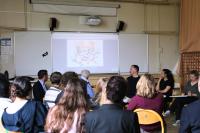
The first session, led by Lancelot Arzel, the MMT’s educational director, focused on the commemoration of terrorism through the Museum-Memorial project. The students learned how the mass attacks of 2015 and 2016 led the government and victims’ organizations to develop a policy for preserving this memory. They were also invited to reflect on the various definitions of terrorism, on objects that might be included in the museum’s collections, and on examples of museums and memorials abroad, such as the National September 11 Memorial & Museum in New York or the Centro Memorial de las Víctimas del Terrorismo in Vitoria-Gasteiz, Spain. These discussions provided an opportunity to address the concept of a victim as well as the challenges surrounding the commemorations planned for 2025–2026.
© Claire Sécail / GIP MMT
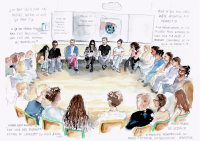
The second session featured a meeting with Hager Ben Aouissi, a survivor of the July 14, 2016, attack in Nice and president of the association Une voie des enfants. During a particularly insightful discussion, the students asked her about her experience of the attack, the physical and psychological consequences it caused, as well as the role of trials in the victims’ journeys and their restorative dimension. The discussion also focused on the place of the Nice attack in the collective memory of contemporary terrorism and on the recognition of child victims. Finally, the session provided an opportunity to explore how testimonies are passed down, particularly through the presentation of several objects entrusted to the Museum-Memorial of Terrorism.
© GIP MMT
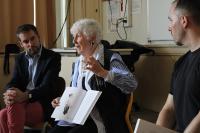
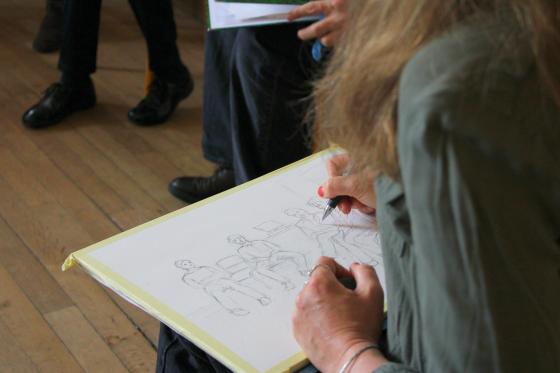
The third session was devoted to terrorism trials and the role of the justice system in shaping history and memory. The students met with Noëlle Herrenschmidt, a courtroom artist who covered the trial of the November 13, 2015, attacks (“V13”), as well as Claire Sécail, a historian, scientific advisor at the MMT, and also a courtroom artist. This meeting provided an opportunity to revisit Noëlle Herrenschmidt’s work during the major trials for crimes against humanity in the 1980s and 1990s (Klaus Barbie, Paul Touvier, Maurice Papon), before discussing her several-month-long involvement in the V13 trial. The discussion focused on the role of courtroom sketching in this type of trial, the techniques used, and the challenges involved in depicting both the defendants and the victims. Claire Sécail, who created a watercolor painting during the event, also highlighted the role of audiovisual technology used during the V13 trials, the Nice attack, and the first trial concerning the assassination of Samuel Paty.
Far from being supplanted by video footage, courtroom sketching offers a unique and complementary perspective on the proceedings. The students thus explored the MMT’s collections dedicated to these trials, which include, in particular, nearly 300 sketches by Noëlle Herrenschmidt from the V13 trial, as well as Claire Sécail’s sketches from more recent terrorism trials.
The Museum-Memorial of Terrorism supports teachers in their educational projects focused on terrorism, its history, and its legacies. It provides them with educational resources, coordinates presentations by witnesses, and offers cultural events designed to enrich teaching practices.
For more information: lancelot.arzel@memorial-terrorisme.fr, pedagogie@memorial-terrorisme.fr
© GIP MMT